
Keeping Insulin Cold When the Power Goes Out
A recent guest at Shaky Grounds Cafe asked a very interesting question during her post-game debriefing:
“I rely on insulin and a continuous glucose monitor. What would you recommend I do during a disaster and grid-down situation?”
We spitballed a few of the obvious solutions, including having a generator to keep a refrigerator running. But that raised another question: How much gasoline would you need to store to keep that generator—and refrigerator—running for days or weeks? That's a preparedness problem of its own.
We thought a simpler solution might be to store ice packs in a freezer and, during an extended outage, keep the insulin in an insulated cooler, rotating frozen ice packs into the cooler as needed to keep the temperature down.
Then she brought up something I hadn't considered: insulin must not freeze.
I realized that, beyond making assumptions, I really didn't know the answer. So I told her I'd do some research and get back to her.
This is that research.
First: Insulin doesn't necessarily have to stay refrigerated forever
This was one of the most useful things I learned.
Unopened insulin is generally stored in a refrigerator at 36–46°F (2–8°C). However, many insulin products can be kept at room temperature for a limited period of time—often up to 28 days, depending on the specific insulin. The allowable temperature and duration vary by product, so check the storage instructions for the insulin you actually use.
That distinction matters during a disaster. The goal isn't necessarily to keep insulin refrigerator-cold indefinitely. Depending on the medication, keeping it within its approved room-temperature range may be perfectly acceptable.
There is, however, one universal rule:
Don't freeze insulin.
Insulin that has been frozen should not be used. And that makes our original ice-pack idea a little more complicated.
The rotating ice-pack method

FREE Ice Packs
Ice packs like these are used to ship meal kits like Blue Apron and HelloFresh. Chances are, someone in your neighborhood has a stash they’d love to give away.
Check your neighborhood social site or post an “In Search Of” ad—you may be able to grab them by the boxful for free!
Turns out our “rotating ice pack” idea wasn't too far off.
If your particular insulin needs to be kept refrigerated, frozen ice packs can provide a useful emergency source of cold. The important part is preventing the insulin from coming into direct contact with anything frozen.
Don't put the insulin directly against a frozen ice pack.
Instead, use an insulated cooler and create some separation between the insulin and the ice pack with a towel, cardboard, or another insulating layer. Better yet, put a thermometer inside the cooler next to the insulin so you can monitor the actual temperature rather than guessing.
Know the correct storage temperature for your specific medication and replace or reposition the ice packs as needed.
And don't repeatedly open the cooler. Every time you open it, you're dumping cold air and replacing it with warmer air. Treat it like a tiny refrigerator: open it as infrequently as possible.
There is a catch to this method, though.
You need to have the ice packs already frozen before the power goes out.
That means having a supply of reusable ice packs and enough freezer space to keep them frozen. Fortunately, ice packs are relatively inexpensive—and you may not even need to buy them.
Meal-delivery companies and other services frequently ship products in insulated boxes with reusable cold packs. Ask friends and neighbors if they have extras, or check local community groups. If you have a large freezer or chest freezer, filling otherwise unused space with frozen ice packs can give you a substantial reserve of cold.
A full freezer will generally stay cold longer than an empty one, particularly if you keep the door closed. Exactly how long everything stays frozen depends on the freezer, how full it is, the surrounding temperature, and how often it is opened, so I wouldn't count on a specific number of days.
But the basic idea is sound: you're storing cold energy ahead of time and transferring it to a small insulated container when you need it.
A portable power station and cooler
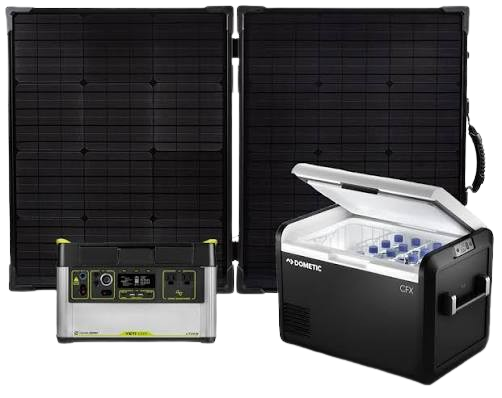
Power Station + Solar Panels + Electric Cooler
A mobile power bank stores electricity (think giant battery) and can keep phones, laptops, and even small appliances like a low-wattage cooler running during an emergency. Pair it with a solar panel to keep it topped off when you need it most.
Another option I like requires a little more investment, but it can solve several other preparedness problems at the same time.
A rechargeable portable power station paired with a solar panel can provide backup electricity for a small refrigerator or cooler, as well as other essential electronics.
For example, Goal Zero currently sells a Yeti 300 power station with a Nomad 50 solar panel for around $540. A setup like this could potentially power a suitable low-power refrigerator or medical cooler, depending on the cooler's actual energy consumption and how much solar energy you're able to collect.
I'd emphasize “suitable” here. Not every inexpensive 12-volt cooler is capable of maintaining the temperature you need for insulin. Some thermoelectric coolers simply lower the temperature a certain amount below the surrounding air temperature rather than maintaining a specific refrigerator temperature.
If you go this route, look for a cooler or refrigerator that can actually maintain the temperature range required by your specific insulin, and check its power consumption before assuming a particular battery/solar setup will work.
The advantage is that you're not buying a power system exclusively for insulin. The same battery could potentially keep phones, radios, rechargeable batteries and other critical equipment running—and could also provide backup charging for the electronics associated with a continuous glucose monitor (CGM) or other medical equipment.
Just remember that solar power isn't magic. Cloudy weather, short winter days, shade and poor panel positioning can dramatically reduce how much energy you collect. Size the battery and solar panel based on the actual power requirements of the equipment you're planning to run.
Evaporative cooling: the low-tech option

Keep things cool - just add water!
The FRIO evaporative cooler activates by simply soaking in water for 10-15 minutes - and then cools for 2-4 days. To re-activate simply soak again.
Another option I wasn't aware of before doing this research is an evaporative cooling case.
Products such as the FRIO cooling wallet don't use ice or electricity at all. Instead, they use water and evaporation to keep their contents cool.
According to FRIO, its cooling wallets maintain temperatures of approximately 64–79°F (18–26°C) for at least 45 hours under specified conditions. When the cooling pouch warms up, you simply reactivate it by soaking it in water again.
This is a completely different approach from the ice-pack method. You're not trying to keep insulin refrigerator-cold. You're keeping it within a temperature range that may be acceptable for insulin that is allowed to be stored at room temperature.
And that's why this option is particularly interesting for a long-term grid-down situation: it doesn't require electricity, a freezer, ice, or a generator. It just requires water.
Again, check the storage requirements for your specific insulin before relying on this method.
So what's the best solution?
For a disaster preparedness plan, I'd think about having layers of options rather than relying on a single solution.
Short-term: A frozen supply of ice packs and a good insulated cooler can provide a useful emergency reserve.
Longer-term: A properly sized battery/solar system paired with an appropriate medical refrigerator or cooler can provide a more sustainable solution.
Low-tech backup: An evaporative cooling case such as FRIO gives you an option that doesn't depend on electricity at all.
And regardless of which approach you choose, I'd recommend having a thermometer in your insulin storage container so you're measuring the temperature rather than guessing.
Most importantly, know the storage requirements for your specific insulin and diabetes equipment before the disaster happens. Your pharmacist, doctor, or the manufacturer's instructions are the best sources for that information.
Build the plan before you need it
If you're preparing for an extended power outage, earthquake, wildfire or other disaster, this is one of those problems that's much easier to solve ahead of time.
Consider having:
Extra insulin and diabetes supplies, within whatever limits are appropriate for you
A small insulated cooler
Several reusable ice packs
A thermometer
A way to keep your ice packs frozen
A backup power source and charging cables
Backup batteries or charging equipment for your CGM, pump, phone or receiver
A backup method for checking blood glucose if your CGM becomes unavailable
A written list of your medications, doses and important medical information
A plan for what you'll do if your primary cooling method fails
The lesson I took away from this conversation is that “the power is out” doesn't necessarily mean “the insulin is going bad.”
There are several ways to manage temperature without relying on a running refrigerator and a gasoline-powered generator. Some require planning and equipment, while others are remarkably low-tech.
And, as with most preparedness problems, the best solution is the one you figure out before you need it.
Important: Insulin storage requirements vary by product. This article is general preparedness information, not medical advice. Check the storage instructions for your specific insulin and diabetes devices, and talk with your pharmacist or healthcare provider about your personal disaster plan.